As the core component for energy conversion, buffering and shock absorption in mechanical systems, the performance of compression springs directly affects the reliability and service life of equipment. In recent years, with the increasing demand for fatigue resistance, corrosion resistance, high temperature resistance and other characteristics of springs in high-end fields such as new energy and aerospace, the industry's exploration in material research and process improvement has continued to deepen. A series of technological breakthroughs are pushing compression springs to upgrade towards "higher strength, longer life, and better adaptability to scenarios".
1, Material innovation: a leap from "universal" to "customized"
Traditional compression springs rely heavily on conventional materials such as carbon steel and stainless steel, but their performance shortcomings in extreme environments are becoming increasingly prominent. Nowadays, material research and development has shifted from "pursuing single strength" to "multidimensional adaptation", and customized materials for different working conditions have become the mainstream trend.
Application of high-strength alloys: A new type of alloy steel wire with added elements such as silicon, vanadium, chromium, etc. By refining the grain structure, the tensile strength of the spring is increased to over 2000MPa, and the fatigue life is extended by 3-5 times compared to traditional carbon steel. This type of material is particularly suitable for high-frequency stress scenarios such as automotive suspensions and high-speed rail braking systems, which can reduce the risk of fracture caused by long-term fatigue.
Breakthrough in materials resistant to extreme environments: In the field of high temperature, nickel based high-temperature alloy springs can maintain stable elasticity in environments above 600 ℃, solving the problem of traditional springs failing due to high-temperature softening in engine turbines and industrial kilns; In corrosive environments, the combination of molybdenum containing stainless steel and coating composite technology has increased the corrosion resistance of springs in marine engineering and chemical equipment by more than 80%.
Exploration of Lightweight Materials: Carbon fiber composite springs are gradually replacing some metal springs due to their high specific strength and lightweight advantages. According to experimental data, its weight is only one-third of that of steel springs of the same specification, and its elastic modulus is more stable. It has great potential in reducing weight and improving the range of new energy vehicles.
2, Process upgrade: transition from "experience manufacturing" to "precision control"
The refinement of manufacturing processes is another key to improving the performance of compression springs. From rolling to heat treatment, parameter optimization in each step of the process is driving the spring quality towards "micrometer level precision".
Intelligent rolling technology: Traditional rolling relies on manual adjustment of parameters, which can easily lead to uneven spring pitch and vertical deviation. Nowadays, automatic spring winding machines equipped with machine vision and AI algorithms can monitor the forming status of steel wires in real time, and control the winding error within ± 0.01mm through a closed-loop control system. At the same time, the combination of 3D modeling and CNC rolling has achieved one-time molding of complex structures for irregular compression springs such as variable diameter and variable pitch, without the need for subsequent modifications.
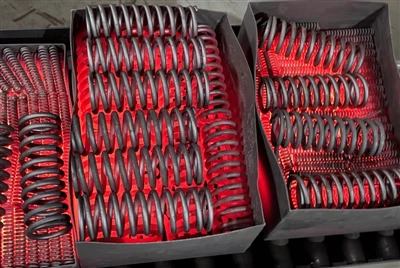
Gradient heat treatment process: Traditional heat treatment uses integral heating, which can easily lead to uneven performance inside and outside the spring. The new gradient heat treatment technology precisely controls the temperature field inside the furnace, forming different hardness gradients between the surface and core of the spring - the surface hardness reaches HRC50-55 to improve wear resistance, and the core hardness is HRC40-45 to ensure toughness, while balancing wear resistance and impact resistance. A certain test shows that the fracture probability of springs using this process under impact load is reduced by 60%.
New surface strengthening technologies: In addition to traditional electroplating and painting, shot peening and chemical vapor deposition (CVD) techniques have become new choices for improving surface performance. Shot peening treatment uses high-speed projectiles to impact the surface of the spring, forming a residual compressive stress layer that offsets some of the tensile stress during operation, significantly improving fatigue strength; CVD technology can deposit a nanoscale ceramic coating on the surface of springs, which does not affect elasticity and can isolate corrosive media, especially suitable for high humidity and high salt environments.

3, Performance testing system: from "sampling inspection" to "full lifecycle monitoring"
To ensure the stability of compressed springs in practical applications, testing technology is also upgrading to "full process traceability".
Online real-time monitoring: Stress sensors and laser calipers are implanted in the production line to record the stress changes and dimensional deviations of springs during rolling and heat treatment in real time. Once abnormalities occur, the machine is immediately stopped for adjustment to avoid batch quality problems.
Simulated working condition testing: Simulate the working state of springs in different environments through equipment such as high and low temperature fatigue testing machines and salt spray corrosion chambers. For example, for the springs of new energy vehicle battery packs, they need to undergo more than 100000 compression tests in temperature cycles ranging from -40 ℃ to 85 ℃ to ensure their elastic stability under extreme temperature differences.
Digital life prediction: Based on big data and finite element analysis, establish a spring life prediction model. After inputting material parameters, working load and other data, the theoretical life of the spring can be accurately calculated, and the remaining life can be dynamically updated based on vibration and temperature data in actual use, providing scientific basis for equipment maintenance.
Summary:
Every technological iteration of compression springs, from materials to processes, responds to the industrial pursuit of "more reliable and efficient". With the deep integration of intelligent manufacturing and new material technology, future compression springs will not only become the "elastic supports" of mechanical systems, but also the "intelligent components" that adapt to diverse scenarios, injecting sustained momentum into the development of high-end equipment manufacturing industry.