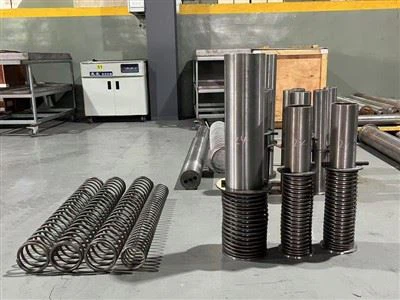
1. Quenching When quenching and heating in a salt bath furnace, the springs should be evenly bundled with iron wires, or the springs should be heated on the mandrel. When heating, ensure that the surface of the spring is oxidized and decarburized. Salt baths should be carefully deoxygenated. It can also be heated in a box-type furnace with a controlled atmosphere. The heating temperature is 850 ° C ± 10 ° C, and the temperature is kept for 10~15 minutes, and the quenching oil is cooled through the furnace.
2. Shot blasting is required to improve the fatigue strength of the spring. The projectile diameter is 0.3~0.5mm. When using compressed air injection, the compressed air pressure is 0.4~0.5MPa; with a centrifuge shot blasting, the linear velocity of the projectile is 70m/s. The service life of the compression spring treated by shot blasting can be more than doubled.
3. After the recrystallization annealing compression spring is rolled and formed, it must be recrystallized and annealed to stabilize the geometric dimensions of the spring and reduce the deformation during quenching. The recrystallization annealing temperature is 550~650℃, and the temperature is kept for 1~1.5h and then air-cooled. A small amount can be carried out in a salt bath furnace, and a continuous resistance furnace can be used to control the atmosphere in large quantities.
4. Tempering can be carried out twice after tempering and quenching. Correction and tempering should be carried out first. The temperature of correction and tempering should generally be lower than the final tempering temperature by about 20 °C, and the temperature should be kept for 10-15 minutes. The final tempering is then carried out, and after the spring size is corrected, the spring is mounted on the tempering jig for final tempering. The tempering fixture should ensure that the pitch and free length of the spring meet the requirements. The tempering temperature is 420℃±10℃, the temperature is kept for 30~35min, and the furnace is water-cooled.