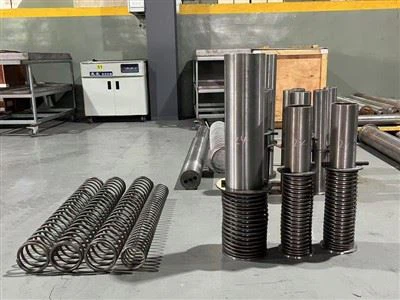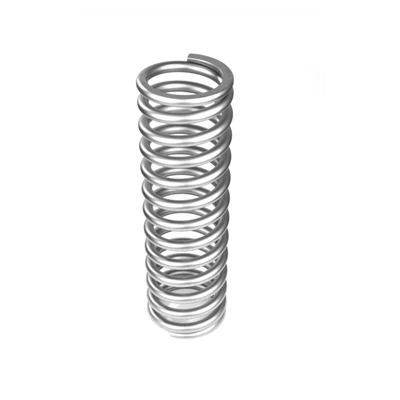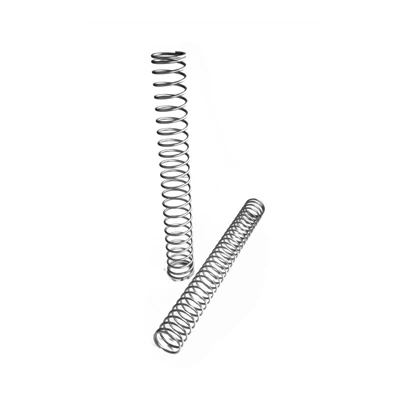
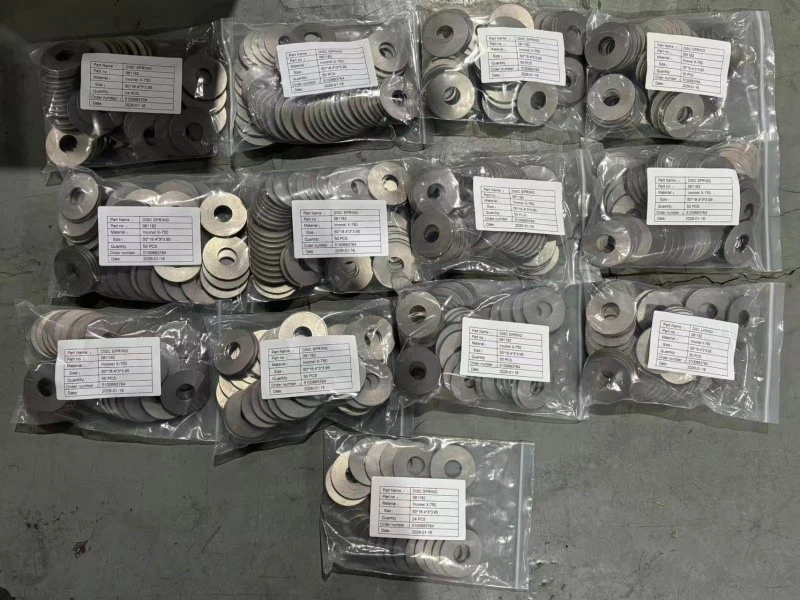
The compression spring and high-temperature preloaded disc spring for heat exchangers are conical metal elastic washers installed on flange bolts.
Core function:It dynamically compensates preload relaxation caused by thermal expansion & contraction, pressure fluctuation and mechanical vibration. It maintains stable gasket sealing specific pressure and effectively prevents medium leakage. It is indispensable for high-temperature and high-pressure heat exchangers, such as floating-head heat exchangers, tube-box and large-end cover flange assemblies.
In extreme high-temperature and highly corrosive service environments, the heat exchanger fastening system - especially bolt preload compensation - imposes stringent requirements on spring materials. Conventional alloy steel will suffer rapid stress relaxation (elasticity loss) and stress corrosion cracking under such harsh working conditions.

So, under high temperature or strong corrosion, which material should be considered for the compression spring disc spring on the heat exchanger?
The following are professional material recommendations for different extreme working conditions:
1,Material Selection Logic Table
| Working Condition | Core Challenges | Recommended Material | Max Operating Temperature |
| Moderate-to-High Temp + General Corrosion | Thermal loss of elasticity, rusting | 17-7PH (631) | 315°C |
| Extreme High Temp (Primary Requirement) | High-temperature creep, stress relaxation | Inconel X-750 | 550°C - 600°C |
| Ultra-High Temp + High Load | Strength degradation, permanent deformation | Inconel 718 | 650°C |
| Strong Acid / Chloride Corrosion | Pitting corrosion, hydrogen embrittlement | Hastelloy C-276 | 400°C |
| Ultra-High Temp + Cyclic Stress | Microstructural instability | Nimonic 90 | 700°C |
2. Detailed Introduction of Key Spring Materials
A. Inconel X-750 (Nickel-Based Precipitation Hardening Alloy) - Universal Standard Grade
It is the standard material for high-temperature heat exchanger disc springs.
Advantages: Ultra-low stress relaxation below 540°C; able to retain design preload steadily after long-term high-temperature operation.
Application: Flange fastening disc springs for large shell-and-tube heat exchangers, and elastic compensation components for plate heat exchanger tie rods.
B. Inconel 718 - First Choice for High Pressure & Heavy-Duty Conditions
Advantages: Higher yield strength than Inconel X-750; ideal for heat exchangers with ultra-high design pressure requiring large spring rebound force.
Characteristics: Excellent high-temperature oxidation resistance; stable mechanical performance from cryogenic to ultra-high temperature range.
C. Hastelloy C-276 (Hastelloy Corrosion-Resistant Alloy) - Professional Grade for Severe Corrosion
For heat exchangers carrying chloride ions, strong acidic media or wet chlorine, ordinary nickel-based high-temperature alloys still face corrosion risks.
Advantages: Outstanding resistance to pitting corrosion, crevice corrosion and stress corrosion cracking.
Limitation: Slightly lower elastic modulus than nickel-based high-temperature alloys; suitable for working conditions where corrosion resistance is the primary demand and temperature is secondary.
3. Why Heat Exchangers Prefer Disc Springs Over Ordinary Compression Springs
In extreme working conditions, disc springs have obvious advantages over cylindrical compression springs:
Limited installation space & high load outputHeat exchanger bolt mounting space is compact; disc springs can provide ton-level heavy load within a small deflection stroke, which is critical to maintain stable gasket sealing pressure.
Flexible combination design
Stacked in parallel: Improve bearing capacity, suitable for ultra-high pressure flange conditions.
Stacked in series: Increase compensation stroke, adapt to heat exchangers with large thermal expansion displacement.
4. Key Design & Application Guidelines
Mandatory age hardening heat treatmentHigh-temperature disc springs must adopt solution treatment + age hardening. Nickel-based alloys without standard heat treatment will lose elasticity rapidly at high temperature, similar to soft iron wire.
Prevent high-temperature seizing & gallingUnder ultra-high temperature, disc springs are prone to thermal adhesion with bolts and flat washers. Surface treatment with molybdenum disulfide spraying or silver plating is recommended for high-temperature lubrication and anti-seize performance.
Reserve fatigue safety marginFor extreme working conditions, design working load shall not exceed 75% of the spring flattening load, to reserve margin against instantaneous thermal shock during equipment start-up and shutdown cycles.
Final Selection Summary:
Pure high temperature, conventional pressure: Inconel X-750
High temperature + high pressure / heavy load: Inconel 718
Strong corrosive chemical medium (chloride, acid): Hastelloy C-276 or 3J21 cobalt-based elastic alloy